.png)
From eBay to Etsy: A Kazakhstan-Registered Autograph Network Selling Suspicious Beckett, PSA, and JSA Items
This investigation changed while I was writing it.
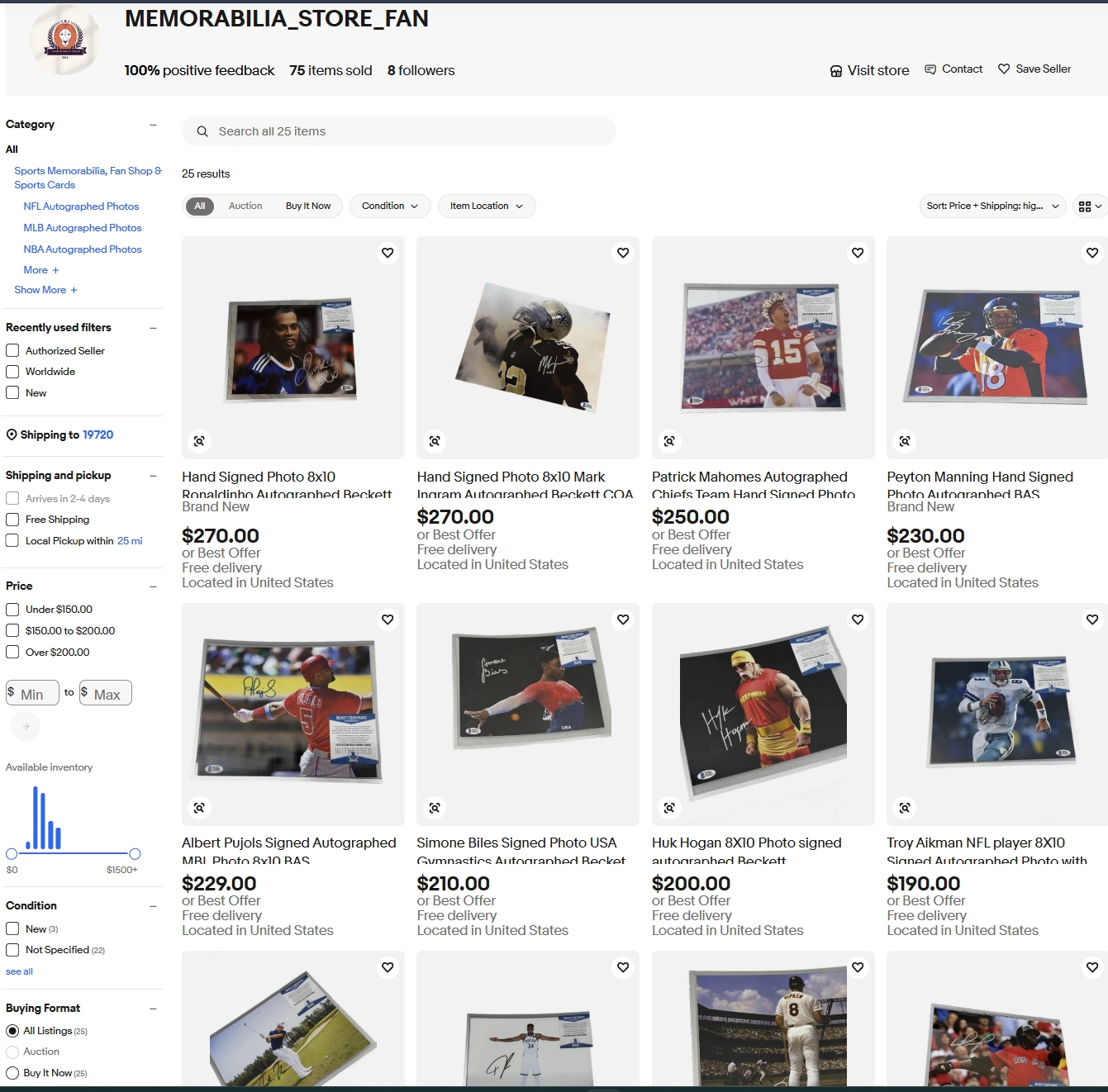
At first, `MEMORABILIA_STORE_FAN` looked like a single clean eBay store selling suspicious autographs with Beckett, BAS, and PSA DNA-style materials. The profile looked normal: 100% positive feedback, 75 items sold, 8 followers, and a mid-market inventory of signed 8x10 photos.
Then I found `PhotoShop00`.
Then I found `Best_Sports_Store1`.
Then I found the same operating pattern on Etsy under `SPORTMEMORABILIA1`.
That changes the case completely. This no longer looks like one questionable seller. It looks like a multi-account marketplace network built to sell suspicious autographed memorabilia to US buyers while hiding the most important account-location signal one click deeper than most buyers ever go.
The public evidence points to the same playbook across the accounts: US item locations, Kazakhstan seller/account registration, 100% positive feedback, mid-market prices, repeated sports and celebrity inventory, and major-authenticator trust signals from Beckett, BAS, PSA/DNA, and now some JSA items.
Important note: this article uses public marketplace pages, public company records, and archived screenshots. It identifies a suspected operating network and calls for platform and law-enforcement review. It does not claim that every named person physically forged every autograph. The question for eBay, Etsy, authenticators, and investigators is who controls the accounts, where the inventory is sourced, and who receives the money.
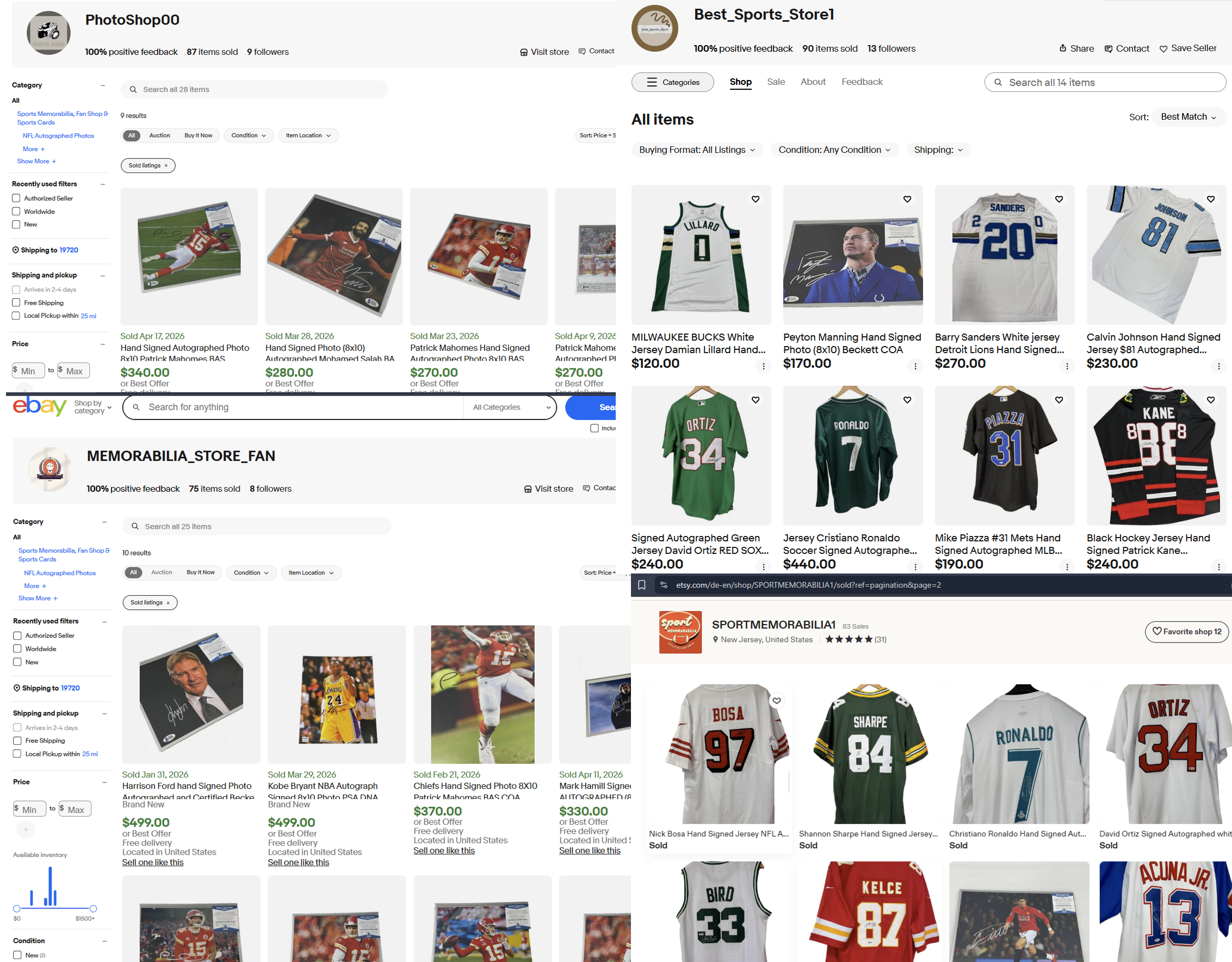
The Accounts
The accounts now connected by the public evidence are:
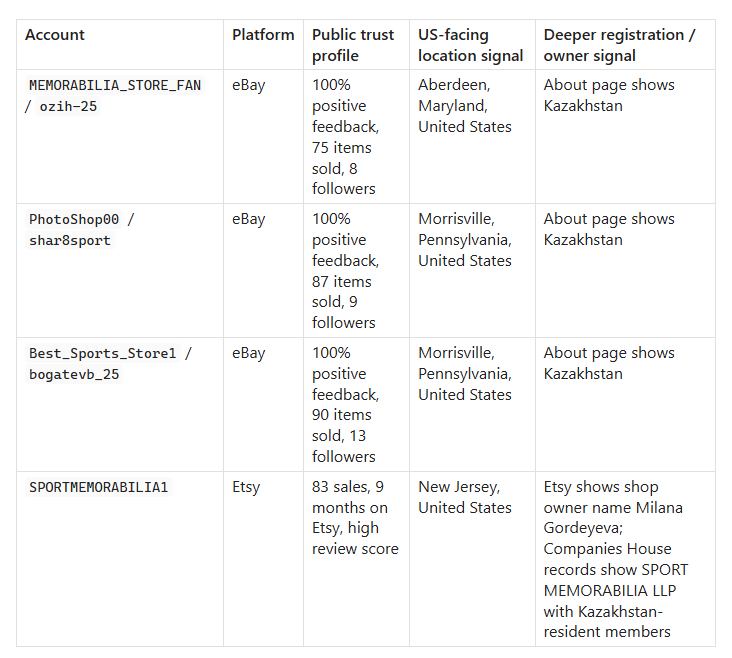
On the surface, each account looks like a normal small memorabilia seller. That is the point.
The scam does not need to look extreme. It only needs to look normal enough for a buyer to trust the sticker.
The Location Trick
This is the most practical buyer lesson in the case.
The eBay listing pages present the inventory as US-located:
`MEMORABILIA_STORE_FAN` listings show item location in Aberdeen, Maryland.
`PhotoShop00` listings show item location in Morrisville, Pennsylvania.
Best_Sports_Store1` listings show item location in Morrisville, Pennsylvania.
But the seller registration signal is not shown in the same place.
A buyer has to open the store, click the About tab, and look at the location field. Almost nobody does that during a quick eBay purchase.
That extra click changes the picture: all three eBay accounts show Kazakhstan on the About page.
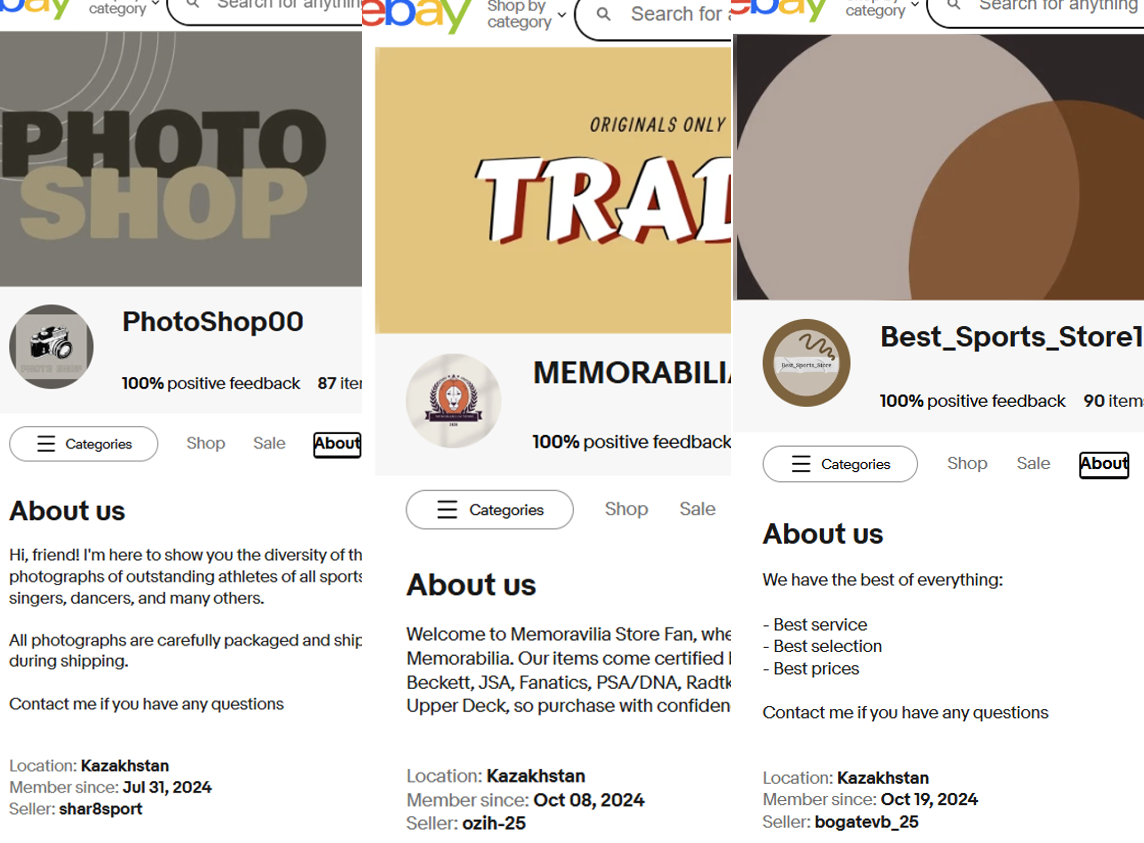
This does not automatically prove where the autographs were produced. The seller could be using US drops, US shipping partners, Kazakhstan-registered accounts, or operators who moved between countries. But in an authentication-heavy category, the mismatch matters.
Collectors should check two different things before buying autographs on eBay:
1. The item location on the listing. 2. The seller registration country on the seller About page.
A US item location does not mean the seller account is actually US-based.
Why This Looks Like One Network
The accounts are not connected by one single detail. They are connected by a stack of repeated details.
The same categories appear again and again: Kobe Bryant, Ronaldinho, Klay Thompson, Harrison Ford, and other high-recognition names. The products are mostly signed photos and jerseys. The price points sit in the middle of the market, usually low enough to feel like a deal but not so low that casual buyers immediately assume fraud.
The listing photography also repeats the same operational style. Items are often photographed at a slight angle or in a semi-rotated presentation, with the certificate card or sticker positioned as the main trust signal. The buyer is not being asked to study the signature. The buyer is being trained to see Beckett, BAS, PSA/DNA, or JSA and stop thinking.
The storefronts also share the same trust-building posture:
Clean feedback.
US-facing item locations.
Broad sports and celebrity inventory.
Major-authenticator brand names in listing titles and descriptions.
No obvious low-effort scam presentation.
Kazakhstan account registration hidden behind the About tab.
The possible supply-chain question is still open. Based on patterns CheckCOA has seen in other counterfeit autograph cases, a China-linked production route is a serious possibility, but the screenshots alone do not prove manufacturing origin. The Kazakhstan connection may also be operational rather than creative: these could be Kazakhstan-linked drops, nominee accounts, or account holders used for registration and payouts. That is exactly why platform data matters. eBay, Etsy, payment processors, and law enforcement can see the account-control, payout, shipping, and supplier records that public buyers cannot.
This is why I no longer see the case as a single seller problem. It looks like account-network behavior.
The Kobe Bryant Sequence
The clearest cross-account comparison is Kobe Bryant.
Kobe is one of the most aggressively forged autographs in the hobby. A genuine, properly authenticated Kobe item usually does not need to be discounted into a bargain bin. That makes Kobe a useful stress test for this network.
Here are the certificate numbers visible in the current evidence:
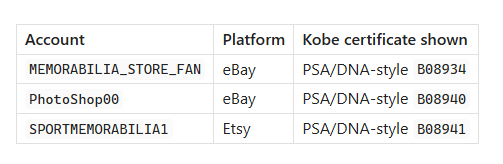
This is not a claim of exact cross-seller reuse. It is more interesting than that.
The PhotoShop00 and Etsy Kobe certificates are only one number apart: `B08940` and `B08941`. The MEMORABILIA_STORE_FAN Kobe certificate sits only six numbers lower than PhotoShop00's `B08940`. That creates a tight certificate cluster across different marketplace accounts.
The visual comparison is the problem. The autographs do not read like natural adjacent pieces from a coherent signing sequence. They look structurally different, even though the accounts are using the same player, the same trust signal, and the same old PSA/DNA-style presentation.
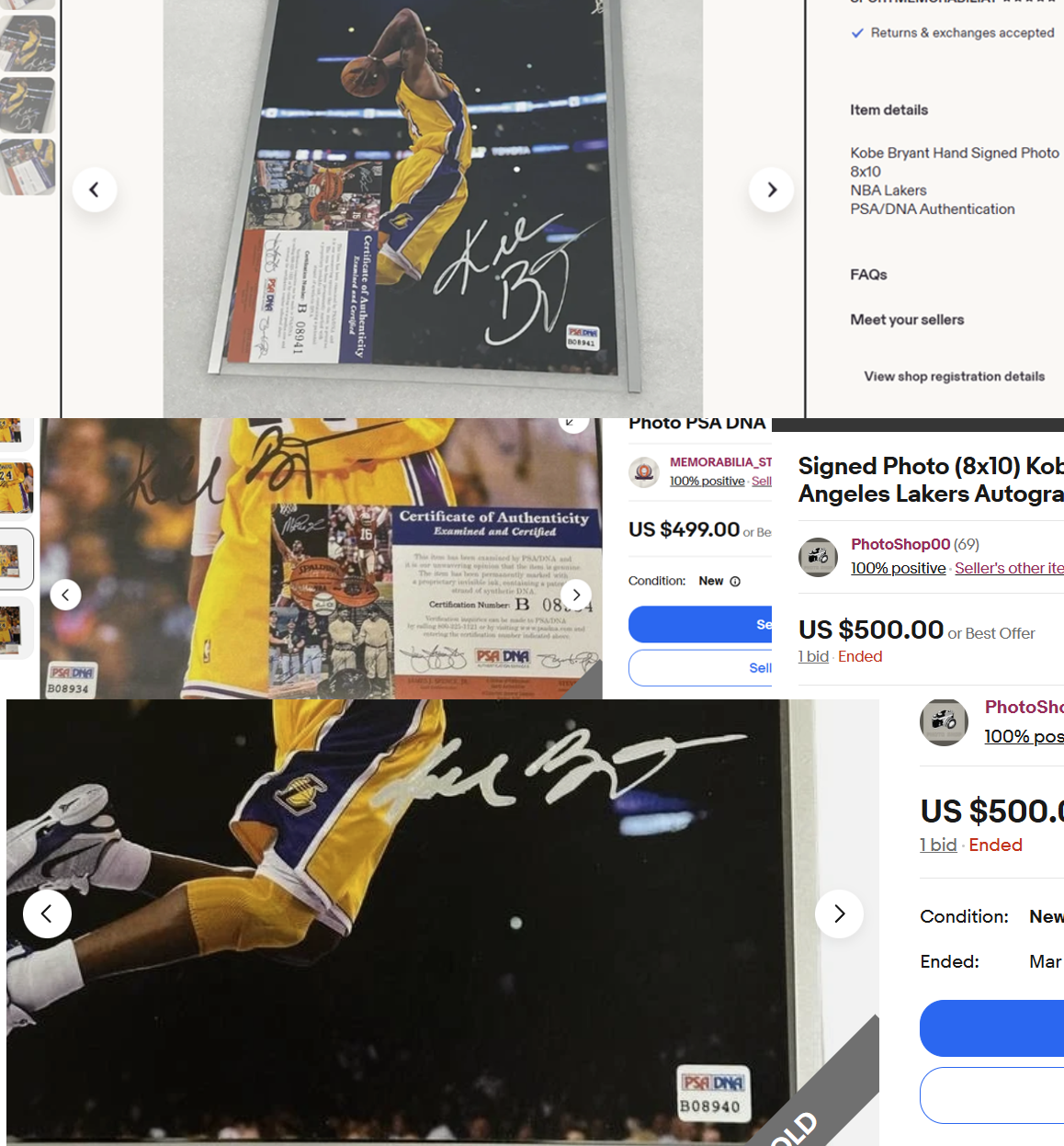
This is exactly the type of pattern that can fool buyers. An older-looking PSA/DNA card feels more believable than a brand-new obvious fake. A 100% feedback seller feels safer than a zero-feedback throwaway account. A US shipping location feels local. The fraud is built around those assumptions.
Harrison Ford and the Steve Grad Reference Point
The Harrison Ford item is the strongest celebrity example because it gives us a useful outside reference.
`MEMORABILIA_STORE_FAN` sold a Harrison Ford signed photo with Beckett Witnessed-style materials.
The visible certificate number is `J50096`, and the CheckCOA record shows a Beckett Witnessed signing dated November 28, 2017 in Santa Monica, California.
The issue is not that the autograph looks messy. It is almost the opposite: it looks too clean for the period it is supposed to represent.
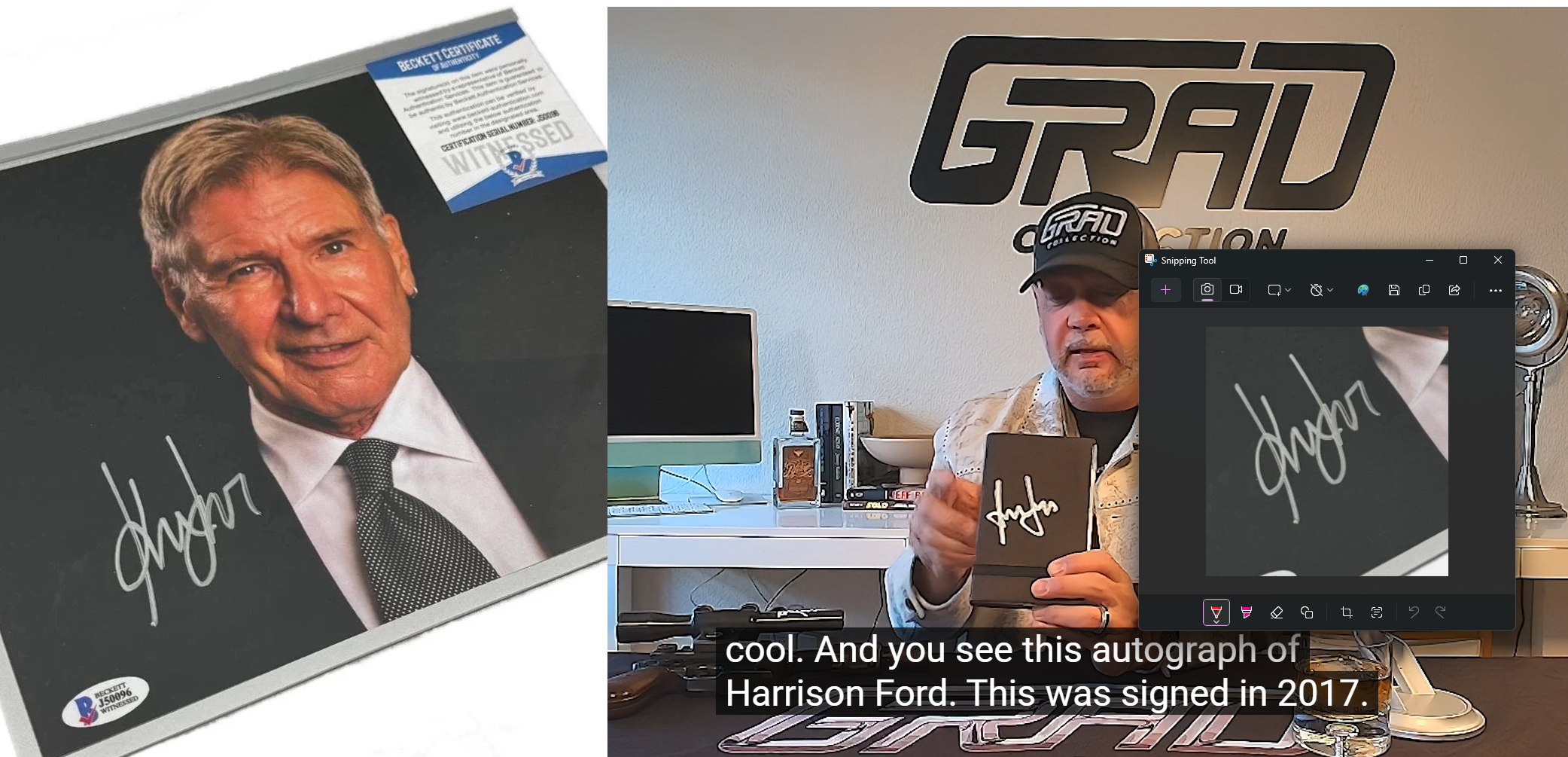
Steve Grad recently published a video about the evolution of Harrison Ford autographs.
In that video, he shows a Harrison Ford signed Indiana Jones book from 2017 and discusses how Ford's autograph changed over time.
Anyone collecting Harrison Ford should watch it:
The 2017 comparison matters. Ford's later-period signature is not the neat, display-friendly version many collectors remember from earlier years. By that point, the autograph had become rougher, more abbreviated, and less polished. The seller's "2017 witnessed" Ford looks like the kind of pretty Ford autograph counterfeiters want buyers to see, not like the 2017 reference Steve is holding in the video.
Steve, if you see this: you recently made a useful Ford video, and this is exactly why it matters. Here is a "Beckett Witnessed" Harrison Ford being sold at a bargain price while the nearest credible examples are usually several times higher.
The JSA Question
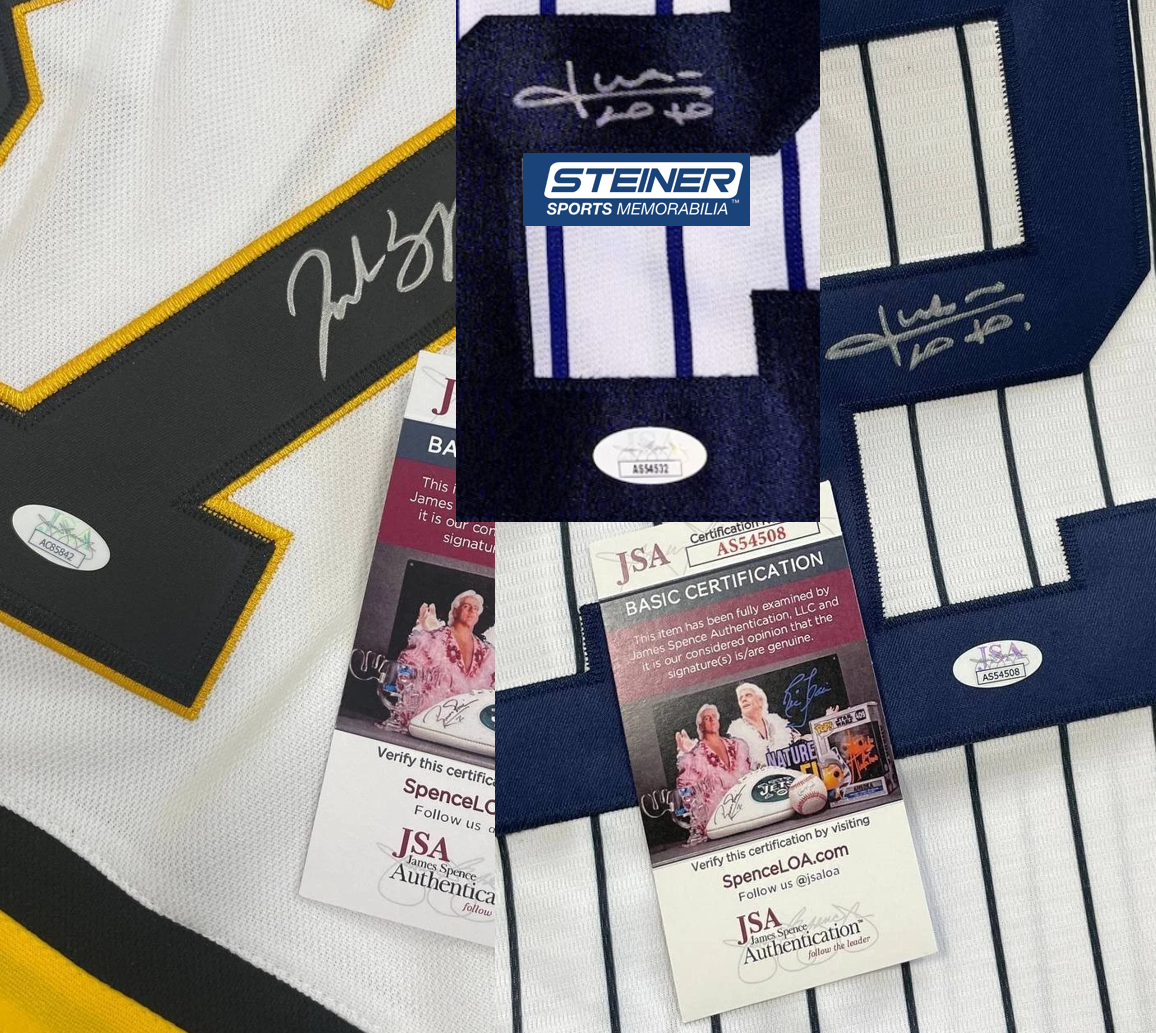
Most of the original evidence focused on Beckett/BAS and PSA/DNA-style materials. The newer screenshots add another layer: some items in the network use JSA-branded certificates and stickers.
I am treating this as an unresolved red flag, not the final proof by itself.
The JSA stickers in the new examples have a very strong holographic effect that I personally have not seen in this form before. That does not automatically make them fake. Sticker production can change, lighting can exaggerate holograms, and screenshots are imperfect. But in the context of this network, the JSA material deserves direct review.
I sent a request to JSA asking for comment. At the time of this draft, I have not received a response. I also posted the examples to Reddit to see what experienced collectors say.
The Etsy and Company Trail
The Etsy shop `SPORTMEMORABILIA1` is important because it moves the case beyond eBay.
Etsy publicly shows the shop as `SPORTMEMORABILIA1`, located in New Jersey, United States, with 83 sales and 9 months on Etsy. Etsy also shows the shop owner name as Milana Gordeyeva.
Public Companies House records show `SPORT MEMORABILIA LLP`, company number `OC456554`, incorporated on April 29, 2025. Companies House lists two active designated members: Milana Gordeyeva and Alina Gubina. Both are shown with country of residence Kazakhstan.
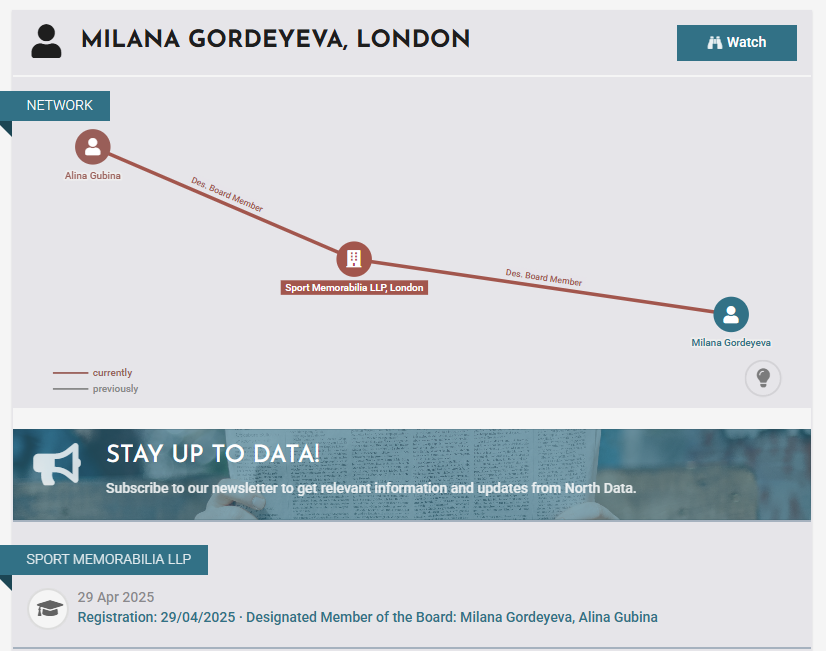
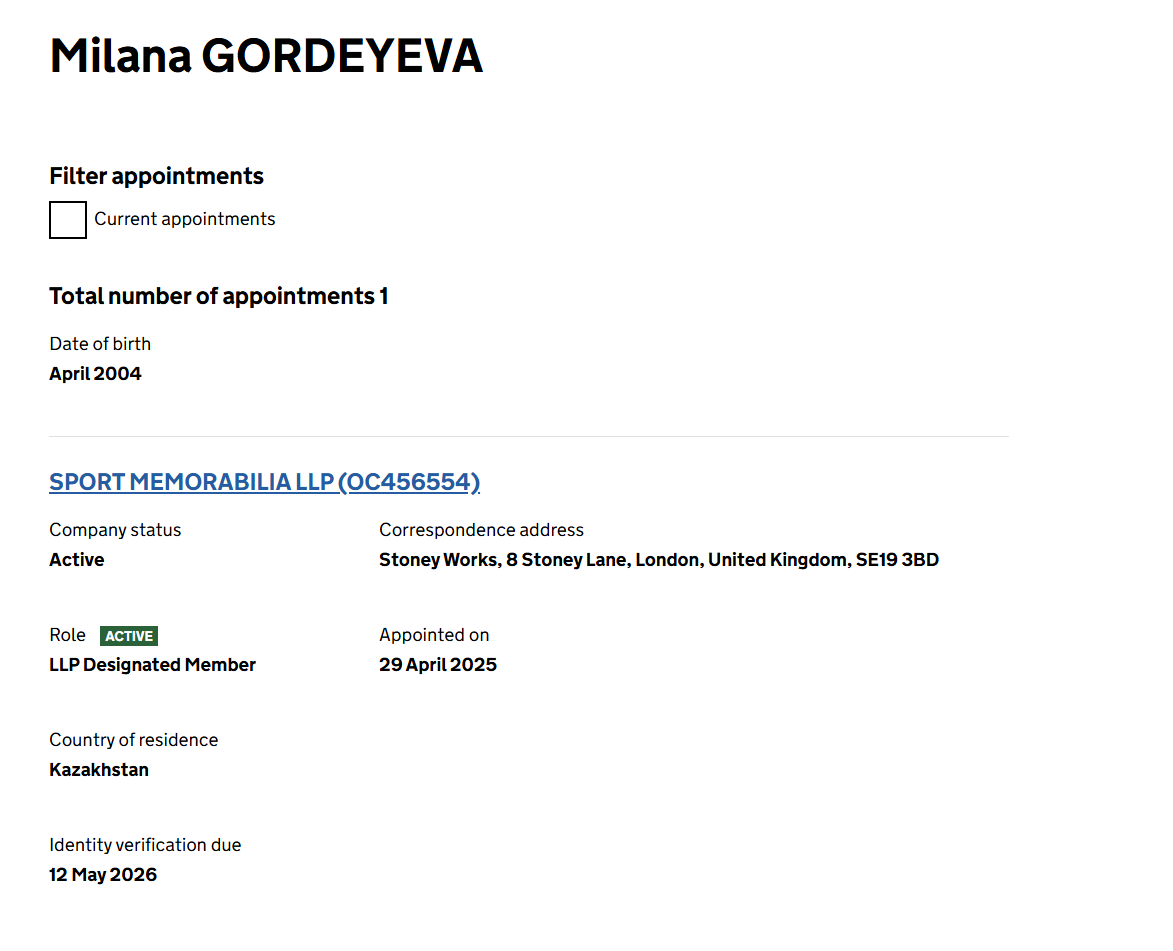
One detail makes me cautious about over-attributing the whole operation to the person named on the public company record. The Companies House officer record indicates a 2004 birth year for Milana Gordeyeva. If that record is accurate, I do not find it likely that a 21 or 22-year-old personally built the full counterfeit autograph supply chain, marketplace account network, certificate materials, US shipping setup, and payout infrastructure alone.
The more realistic investigative hypothesis is that Kazakhstan-linked identities may be used as drops or nominee operators. They may register companies, receive payouts, manage storefronts, or provide identity infrastructure for a larger operation. That is not something public screenshots can fully resolve. It is exactly the kind of question eBay, Etsy, payment processors, and law enforcement should answer with non-public account and financial records.
The reasonable public conclusion is not "one company record proves everything." The reasonable conclusion is that there is now enough marketplace, certificate, company, and Kazakhstan-linked operator-trail evidence for a formal review.
The Business Model
The model appears to be simple:
1. Register or operate marketplace accounts that look normal.
2. Present inventory as US-located.
3. Use Kazakhstan-registered account infrastructure, likely including drops or nominee account holders.
4. Sell mid-market autographed memorabilia with major-authenticator branding.
5. Keep prices low enough to move inventory quickly, but high enough to make each sale meaningful. 6. Rely on buyer feedback systems that reward delivery, not authenticity.
This is why the feedback scores are misleading.
Autograph fraud often creates happy buyers at first. The package arrives. The photo or jersey looks like the listing.
The certificate card is included. The buyer leaves positive feedback.
Only later, when the item is resubmitted, resold, or reviewed by someone knowledgeable, does the problem become obvious.
By then, the same feedback that came from victims helps the next victim feel safe.
What CheckCOA Has Already Logged
The three eBay stores have now been processed into the CheckCOA Fraud Alert database:
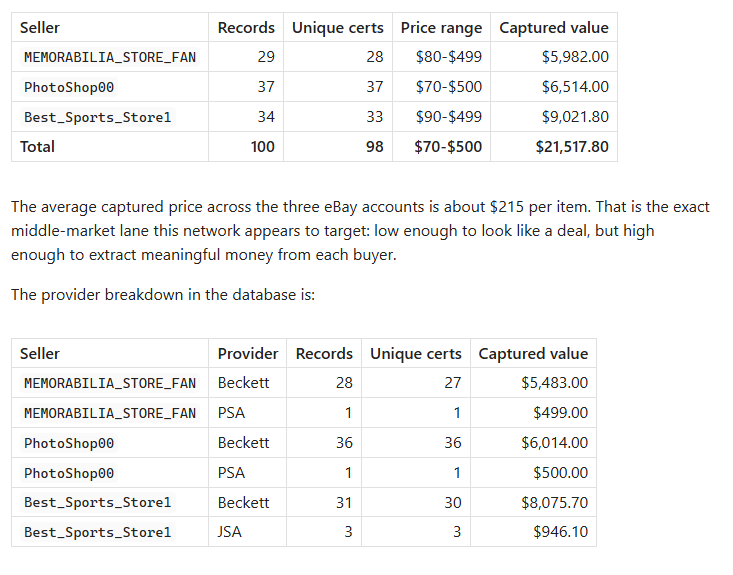
This is still a conservative snapshot. eBay only exposes a limited recent sold-history window, and older sales are often unavailable after roughly 90 days. Some listings may also disappear, be relisted, or be hidden by marketplace search behavior. The real lifetime volume across these accounts may be higher than the captured value above.
The database did not show exact cross-seller certificate reuse among these three eBay accounts. The new evidence is different: it shows a broader account network with near-sequential certificate clustering, repeated inventory categories, repeated marketplace behavior, and now an Etsy/company-record trail.
The Etsy shop `SPORTMEMORABILIA1` is not fully processed yet. Its certificate numbers still need a separate validation and import pass.
What Should Happen Next
eBay should immediately review and preserve evidence for:
`MEMORABILIA_STORE_FAN` / `ozih-25`
`PhotoShop00` / `shar8sport`
`Best_Sports_Store1` / `bogatevb_25`
That review should include listing history, sold-item history, IP and device data, payout beneficiaries, shipping labels, return addresses, buyer complaints, message history, and account-linking signals. The accounts should be suspended while the evidence is preserved.
Etsy should review `SPORTMEMORABILIA1`, the shop owner record, related payout information, and any linked business-registration details.
The FBI and IC3 should review this as suspected cross-border marketplace fraud. The public evidence now points beyond a single bad eBay seller and into a possible account network using US-facing marketplace listings, Kazakhstan registration, UK company infrastructure, possible drop/nominee account holders, and sports-authentication trust signals to take money from American buyers.
Buyer Advice
If you collect autographs, do not stop at the sticker.
Check the certificate number. Compare the signature to period-correct examples. Check the seller's other inventory. Save the listing photos. Look at sold prices for credible examples. And on eBay, always check the seller About page, not just the item location on the listing.
If a Harrison Ford or Kobe Bryant autograph is priced 3-4 times below credible market examples, assume there is a reason.
The certificates already verified from the three eBay accounts have been added to the CheckCOA Fraud Alert database. Etsy certificates are next.
Verify before you buy: https://checkcoa.com
Public Sources
Etsy shop page: SPORTMEMORABILIA1
Companies House overview: SPORT MEMORABILIA LLP, OC456554
Companies House officers: People for SPORT MEMORABILIA LLP
Companies House PSC page: Persons with significant control
Steve Grad video: Harrison Ford autograph evolution
Comments 0